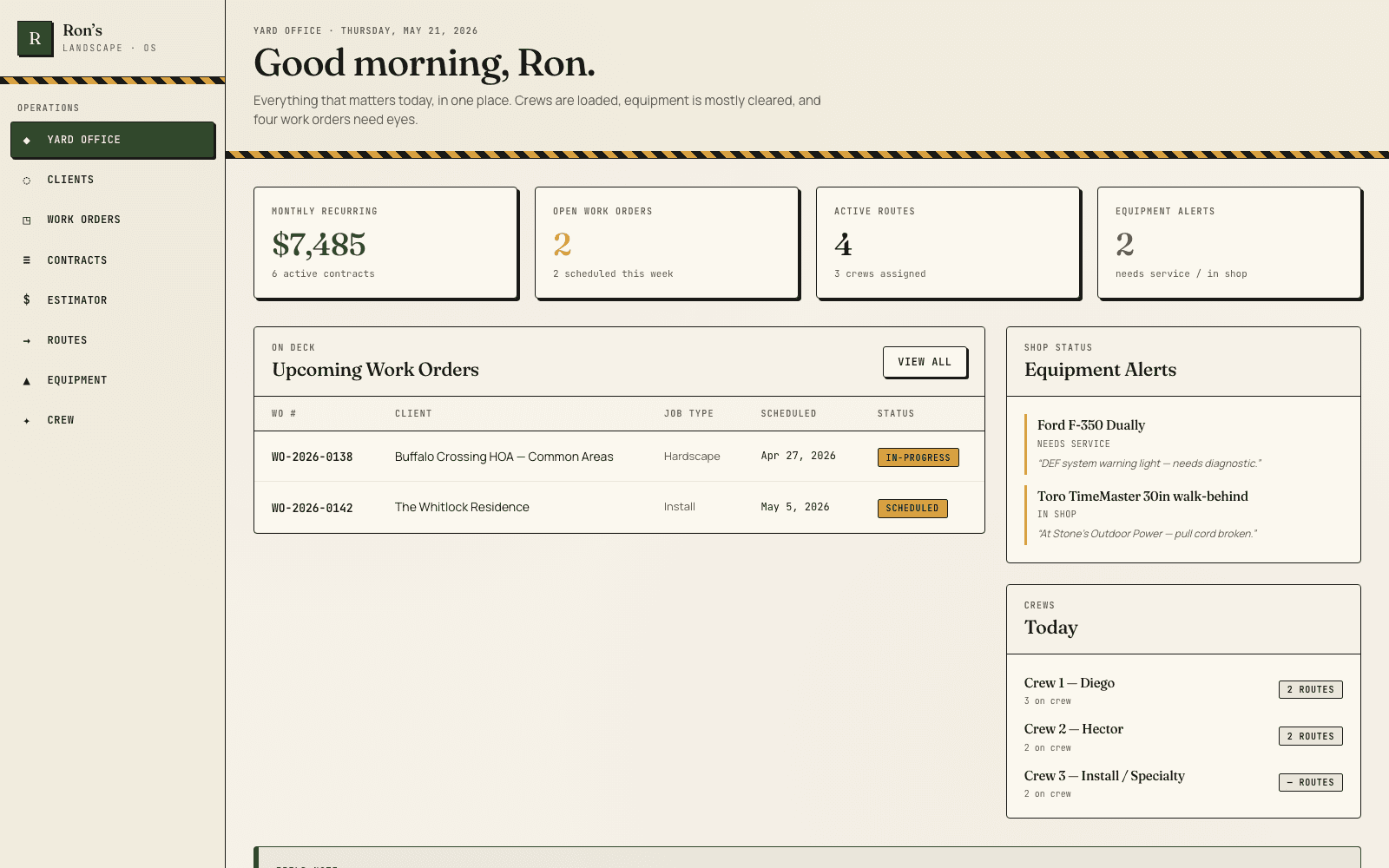
The outcome
- The office and the field share one picture instead of reconciling several.
- Estimating and contracts follow how the business actually sells, not a tool's assumptions.
- Routing and dispatch live where the crew is.
- A foundation built to grow with the operation rather than be replaced by it.
The challenge
As job volume and crew count grew, the office spent more and more time coordinating — and the field spent less time working. A growing landscaping company ran its operation across paper, texts, and a stack of spreadsheets, with crew routing, client contracts, equipment, and estimates each living somewhere different.
How we did it
We built a single workspace that unifies the operation into modules designed around the real workflow, not a generic CRM:
- Client and work-order management
- Contracts and recurring service agreements
- Estimating built for how the company actually prices jobs
- Crew routing and daily dispatch
- Equipment tracking
- Crew accountability
The whole surface is field-first — usable from a phone in the truck — on an architecture that maps cleanly onto a production database as the company scales.